
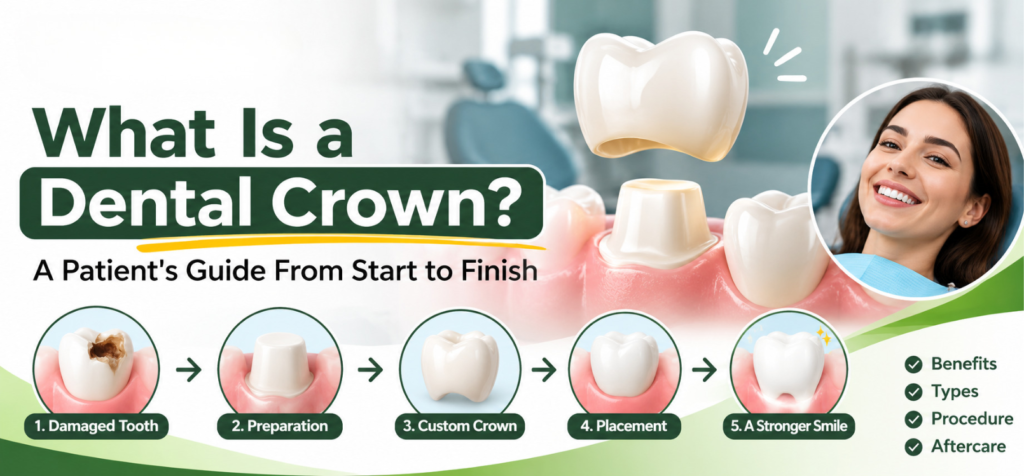
Your dentist just told you that you need a crown. Maybe you cracked a tooth on a popcorn kernel, or an old filling finally gave out. Either way, you probably have questions: What exactly is it? Will it hurt? And how much is this going to cost?
This guide answers all of that in plain language, so you can walk into your appointment knowing what to expect.
Quick answer: A dental crown is a custom-made cap that fits over a damaged or weak tooth. It covers the whole visible part of the tooth above the gumline and restores its shape, strength and appearance. Crowns are made from porcelain, ceramic, zirconia, metal or a mix, and most last 10 to 15 years with good care.
What Is a Dental Crown?
A dental crown is a tooth-shaped cover that slips over your natural tooth like a thimble over a fingertip. Once it’s bonded in place, it becomes the new outer surface of that tooth. You chew with it, brush it and floss around it just like any other tooth.
The part of your tooth you can see is also called the “crown,” which is where the name comes from. A dental crown simply replaces that outer layer when the original is too damaged to protect itself.
Crowns are sometimes called “caps.” Same thing, different word.
When Do You Need a Dental Crown?
Dentists recommend crowns when a tooth needs more support than a filling can give. Common reasons include:
- A large cavity that leaves too little healthy tooth to hold a filling
- A cracked or broken tooth that could split further if left alone
- After a root canal, especially on back teeth, which become more brittle afterward
- A worn-down tooth from grinding or clenching (bruxism)
- An old, failing filling that covers most of the tooth
- A dental implant, which needs a crown on top to look and work like a real tooth
- A dental bridge, where crowns on neighboring teeth hold a replacement tooth in place
- Cosmetic reasons, such as a badly stained or misshapen tooth
The goal in most cases is simple: save the natural tooth and keep it from breaking down further.
Types of Dental Crowns
The material your dentist picks depends on where the tooth is, how hard you bite, how much the tooth shows when you smile, and your budget.
| Crown type | Look | Strength | Best for |
|---|---|---|---|
| Porcelain / all-ceramic (incl. E.max) | Most natural | Good | Front teeth and visible areas |
| Zirconia | Natural to very natural | Very strong | Back teeth, people who grind |
| Porcelain-fused-to-metal (PFM) | Natural, may show a dark line at the gum over time | Strong | Front or back teeth |
| Gold / metal alloy | Metallic, not tooth-colored | Strongest, lasts longest | Back molars out of sight |
| Resin (composite) | Fair | Wears faster | Short-term or temporary use |
Porcelain and all-ceramic crowns match the color and shine of natural teeth better than anything else. They’re the go-to choice for front teeth.
Zirconia crowns have become one of the most popular options in US dental offices. They hold up well under heavy chewing and still look like a real tooth.
PFM crowns have a metal base with porcelain on top. They’ve been used for decades and are a reliable middle-ground option.
Gold crowns are rarely chosen for looks, but they’re gentle on opposing teeth and can last for decades.
Temporary crowns are usually made of acrylic or resin. You wear one for a couple of weeks while your permanent crown is made in a lab.
Crown vs. Filling vs. Onlay: What’s the Difference?
A filling repairs a small to medium cavity by filling the hole. It works well when most of the tooth is still strong.
An onlay (sometimes called a partial crown) covers one or more chewing cusps but not the entire tooth. It’s an option when damage is too big for a filling but not big enough for a full crown.
A crown covers the whole tooth. It’s the right choice when the tooth is cracked, heavily filled or weakened from a root canal.
If you’re unsure which one fits your situation, ask your dentist to show you your X-rays and explain why they’re recommending one over the other.
The Dental Crown Procedure: Step by Step
A traditional crown usually takes two visits about two to three weeks apart.
Visit 1: Preparing the tooth
- Exam and X-rays. Your dentist checks the tooth, roots and surrounding bone. If there’s deep decay or infection, you may need a root canal first.
- Numbing. A local anesthetic numbs the tooth and gums so you feel pressure, not pain.
- Shaping the tooth. The dentist removes decay and trims a thin layer from the outside of the tooth so the crown can fit over it. If a lot of the tooth is missing, they may build it up first with filling material (a “core buildup”).
- Taking impressions. Your dentist takes a digital scan or a traditional mold of the tooth. This is sent to a dental lab.
- Choosing the shade. For tooth-colored crowns, the dentist matches the color to your nearby teeth.
- Placing a temporary crown. You leave with a temporary cap that protects the tooth while you wait.
Visit 2: Placing the permanent crown
- The temporary crown is removed and the tooth is cleaned.
- Your dentist tries in the new crown and checks the fit, color and bite.
- Once everything feels right, the crown is cemented or bonded in place.
- Your bite is checked again and fine-tuned if needed.
What About Same-Day Crowns?
Many US offices now offer same-day crowns using CAD/CAM technology (CEREC is a well-known brand). The dentist scans your tooth, designs the crown on a computer and mills it from a ceramic block right in the office. You walk out with your permanent crown in one visit, usually in about two hours. Not every case is a good fit, so ask your dentist whether it works for your tooth.
Does Getting a Dental Crown Hurt?
For most people, no. The tooth and gums are fully numbed during the preparation, so you’ll feel pressure and vibration but not sharp pain.
After the numbness wears off, it’s normal to have some mild soreness in the gums and a bit of sensitivity to hot and cold for a few days. Over-the-counter pain relievers usually handle it. If the pain gets worse instead of better, or your bite feels “high” when you close, call your dentist. A quick adjustment often fixes it.
How Long Do Dental Crowns Last?
Most dental crowns last 10 to 15 years, and many last 20 years or more. Gold and zirconia crowns tend to last the longest.
How long yours lasts depends on a few things:
- How well you brush and floss, especially at the gumline
- Whether you grind or clench your teeth
- Habits like chewing ice, biting nails or opening packages with your teeth
- Where the crown is in your mouth (molars take more force)
- Keeping up with regular dental checkups
The crown itself can’t get a cavity, but the natural tooth underneath still can, right where the crown meets the gum. That’s why daily flossing matters so much.
How Much Does a Dental Crown Cost in the US?
Without insurance, a single dental crown in the US typically costs $800 to $3,000 per tooth. Most patients pay somewhere around $1,000 to $1,800 for the porcelain, ceramic or zirconia crowns dentists use most often.
| Crown type | Typical cost without insurance (per tooth) |
|---|---|
| Porcelain-fused-to-metal (PFM) | $800 – $1,400 |
| All-porcelain / all-ceramic | $1,000 – $2,500 |
| Gold alloy | $1,200 – $2,500 |
| Same-day (CAD/CAM) crown | $1,000 – $2,200 |
2026 national estimates. Your actual price depends on your location, the tooth and your case.
Things that can add to the total:
- Core buildup if a lot of tooth is missing: roughly $200 to $400
- Root canal if the nerve is damaged or infected: roughly $700 to $1,500 extra
- Implant abutment if the crown sits on an implant
Prices also run higher in big cities and coastal states than in rural areas or the Midwest.
Does Dental Insurance Cover Crowns?
Most dental insurance plans treat crowns as a “major” procedure and cover around 50% of the cost after your deductible, as long as the crown is medically necessary. Plans may not cover crowns done purely for cosmetic reasons, and many have waiting periods or yearly maximums, so check your benefits first.
No insurance? A few ways to lower the cost:
- Ask about in-house membership or dental savings plans
- Ask whether the office offers a discount for paying in full
- Look into financing such as CareCredit or monthly payment plans
- Consider a dental school clinic, where students work under licensed dentists
How to Take Care of Your Dental Crown
A crown doesn’t need special treatment. It just needs the same care as your natural teeth, done well.
- Brush twice a day with a soft-bristled toothbrush and fluoride toothpaste
- Floss once a day, sliding the floss out sideways near the crown instead of snapping it up
- Avoid chewing ice, hard candy, pens and fingernails
- Wear a night guard if you grind your teeth
- While you have a temporary crown, skip sticky foods like caramel and gum
- See your dentist every six months for cleanings and checkups
Signs Something Is Wrong With Your Crown
Call your dentist if you notice:
- The crown feels loose or wiggles
- Pain when you bite down
- Sensitivity that doesn’t go away after a couple of weeks
- A chip or crack in the crown
- Swollen, red or bleeding gums around the crown
- A dark line or gap at the gumline
- The crown falls off (save it and bring it with you)
Most of these problems are easy to fix when caught early.
Frequently Asked Questions
What is a dental crown in simple terms?
It’s a tooth-shaped cap that covers a damaged tooth to make it strong and look normal again.
Is a crown better than a filling?
Not better, just different. A filling works for smaller damage. A crown is needed when a tooth is cracked, heavily decayed or weakened after a root canal.
Does getting a crown hurt?
The procedure is done with local anesthetic, so most people feel only pressure. Mild soreness for a few days afterward is normal.
How long does a dental crown last?
Most crowns last 10 to 15 years. With good care, many last 20 years or longer.
How much is a crown without insurance?
In the US, expect about $800 to $3,000 per tooth, depending on the material and where you live.
Can a tooth with a crown still get a cavity?
Yes. The crown can’t decay, but the tooth underneath can, usually at the edge near the gumline. Brushing and flossing keep that area healthy.
Can I eat normally with a crown?
Yes, once your permanent crown is in place. Just avoid very hard things like ice and hard candy that could crack any tooth.
Can a crown be whitened?
No. Whitening products don’t change the color of porcelain or zirconia. If you plan to whiten your teeth, do it before getting a crown so it can be matched to your new shade.
Talk to Your Dentist About Your Options
A dental crown is one of the most common and reliable ways to save a damaged tooth. It protects what’s left of your natural tooth, lets you chew comfortably again and looks just like the teeth around it.
If you have a cracked tooth, a large filling or ongoing tooth pain, don’t wait for it to get worse. Book an appointment at Stamford Dental Studio or call (203) 327-7498. Our team at 95 Morgan Street, Suite 1A, Stamford, CT will walk you through your options, your costs and what your insurance covers before any treatment begins.
This article is for general information and isn’t a substitute for an exam by a licensed dentist.
Related Posts


Ready for a healthier, brighter smile?
Talk to our Stamford dental team — gentle, judgment-free care for every age.