Take the first step toward a healthier, brighter smile. Our team is here to provide personalized care and answer all your questions.
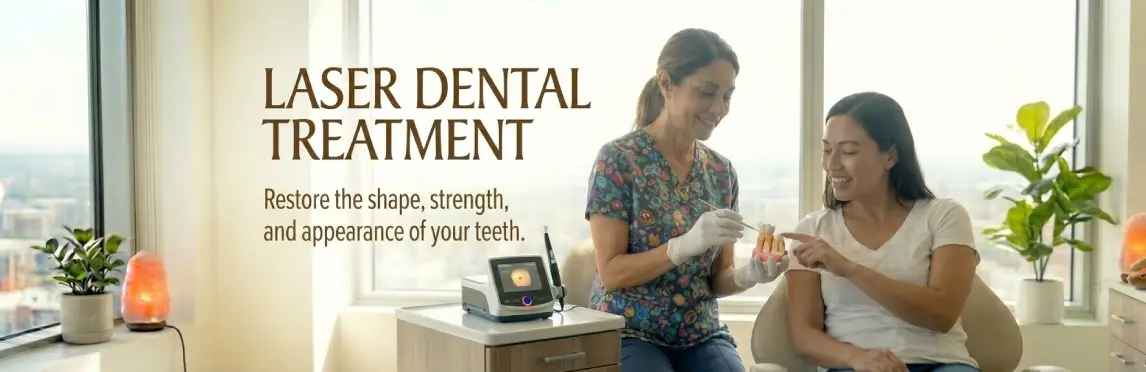
Laser dental treatment utilizes focused light energy for precise, minimally invasive procedures, often reducing the need for anesthesia, drills, and sutures.
Laser dental treatment utilizes focused light energy for precise, minimally invasive procedures, often reducing the need for anesthesia, drills, and sutures. It is commonly used for cavity removal, gum reshaping, periodontal therapy, and teeth whitening. Benefits include faster healing, reduced bleeding, and less pain, though risks like minor discomfort or burning sensations may occur.
Laser periodontal therapy is a minimally invasive, FDA-cleared procedure (such as LANAP) used to treat gum disease by using dental lasers to remove bacteria and diseased tissue from periodontal pockets without cutting or sutures. This technique promotes regeneration of healthy tissue, causes less pain and bleeding than traditional surgery, and usually involves a faster recovery.
A beautiful, bright white smile helps build self-confidence and enhances oneÔÇÖs appearance. The most effective cosmetic dentistry procedure nowadays is laser tooth whitening. In laser tooth whitening, the whitening gel works with the laser light to quickly whiten your teeth. Many people choose it for its quick, noticeable results. However, like any cosmetic treatment, it also has advantages and disadvantages.
Laser teeth whitening is a professional in-office dental procedure designed to whiten teeth quickly and effectively. In this method, the bleaching gel is applied to the teeth, then activated with a laser that removes stains caused by coffee, tea, smoking, wine, aging, and certain medicines.
The entire process, which depends on the severity of the stains, lasts 30 to 60 minutes.
One of the major benefits of laser teeth whitening is its speed. Patients can see their teeth lighten by several shades after just one visit. That makes laser teeth whitening ideal for use before weddings, job interviews, parties, and other important occasions.
This process is performed by a dental practitioner who carefully aims at the stained areas without harming the gums or adjacent tissues. The treatment will provide better, more consistent results than any other over-the-counter whitening treatment.
Proper dental hygiene and care will keep your laser-whitened teeth for months or even years. Not smoking and eating foods that do not stain your teeth may extend the duration of the whitening period.
Most patients report no discomfort during laser whitening. Patients have noted lower irritation than with ordinary whitening strips or trays.
Laser whitening helps whiten teeth stained from coffee, tea, smoking, and age spots, which may not be easily treated with ordinary tooth whitening pastes and kits.
Laser teeth whitening costs more compared to home tooth whitening kits. The professional method of tooth whitening is much pricier because it requires advanced equipment.
Some individuals feel temporarily sensitive to hot and cold foods after treatment. Sensitivity normally lasts a few days but can be bothersome for individuals with naturally sensitive teeth.
There may be irritation of the gums and other soft oral tissues when the teeth-whitening material or laser was not adequately protected during the procedure. Working with an experienced dental professional will help avoid such complications.
Laser teeth whitening is not permanent, as food and beverages such as coffee, tea, and red wine, as well as smoking, can eventually cause staining. Follow-up appointments may be required.
Individuals who have cavities, gum disease, thinning or worn enamel, teeth that have been crowned or veneered, and those whose teeth are very sensitive are not suitable candidates for the procedure.
Laser whitening may be suitable for people who:
In fact, it might not be advisable for people who have pregnancy complications, untreated dental conditions, or who have many dental restorations.
These habits can help your whitening results last longer.
Laser teeth whitening is one of the quickest ways to improve your smile, as it is an efficient cosmetic dental procedure. This process provides great results and is very easy to use for stain removal. Nonetheless, it has limitations: it is expensive, can cause temporary tooth sensitivity, and requires maintenance.
Before getting your teeth whitened using laser technology, it is prudent to see a dentist first.
This page provides general educational information and is reviewed for accuracy. Treatment recommendations are made after individual evaluation.

Welcome to Stamford Dental Studio. Our passionate team is fully committed to delivering personalized, top-tier dental care that you genuinely deserve.
Copyright © 2026 Stamford Dental Studio