

Stamford Dental Studio is focused on the overall health and development of your child’s smile. At Stamford Dental Studio, we want to set children up with a solid foundation for a lifetime of healthy teeth so they can enjoy the benefits of a healthy, attractive smile.
Excellent Oral Health Begins With Good Oral Care
At Stamford Dental Studio, good oral health begins with proper preventive care from a young age. By beginning regular dental check-ups and home care routines early in life, we can monitor your child’s dental growth and help ensure that their smile grows strong and healthy. Preventive dentistry not only protects against cavities and other oral health issues but also helps your child feel confident and have a positive self-image.

At our office, we take care of your child’s oral health with compassion and skill. Here at Stamford Dental Studio, we offer a wide variety of dental services to meet the needs of children of all ages. Whether you are bringing your child for their first dental visit or for an emergency, we are prepared to provide the care they need.
We want to keep your child healthy by providing all the information and tools necessary to teach them how to brush their teeth easily and correctly, floss every day, eat healthy foods that will help protect their teeth and gums from cavities and gum disease, and avoid any behaviors that could lead to adverse effects on their oral health. We want each visit with your child to be fun, enjoyable, and valuable.
The Importance Of Regular Checkups And Routine Care
Research indicates that kids and adolescents are losing 51 million school hours annually due to dental issues. To ensure your child has the best oral health and a healthy and bright smile, we advise regular dental visits and cleanings twice a year.
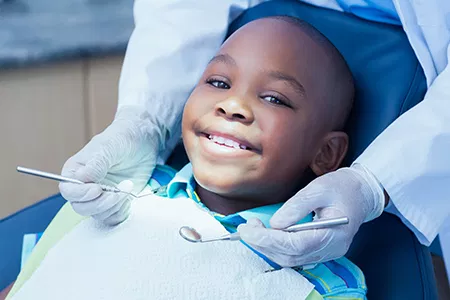
Because we are highly trained and experienced in caring for children, we are aware of the different phases of dental development and how to address your child’s specific needs. At each routine appointment, one of our professional dental hygiene staff will review your child’s medical history and dental history, and complete a thorough clinical examination of your child’s teeth, gums, jaw and oral tissues surrounding the mouth. We will also evaluate the relationship between your child’s teeth, their jaw and what is known as their ‘functional bite’.
To assess what may be happening beneath the surface, we will utilize digital radiographs (x-rays) as required, to assess whether there are cavities, any infections present, and the development of the teeth above and beneath the surface of your child’s gums, and how healthy the jawbone surrounding your child’s developing teeth is. In addition, we will perform a professional dental cleaning (or prophylaxis) to remove plaque/debris from between the teeth and in hard-to-reach areas that are difficult to clean with brushing/flossing.
Tooth Decay Is The Single Most Common Chronic Childhood Disease
Tooth decay is the most prevalent chronic disease in children—but it is also one of the most preventable conditions with proper care and advice. At Stamford Dental Studio, we track your child’s oral health at every stage of their development and offer personalized advice to help keep their smile healthy and strong.
We teach parents and children proper brushing and flossing techniques, which foods and drinks cause cavities, and harmful oral habits that can affect dental development. Although developing a healthy oral hygiene habit can sometimes be difficult, our staff offers helpful advice on making brushing and flossing fun and easy. As your trusted dental professional, we are dedicated to helping your child maintain a healthy smile from infancy through adolescence.
Simple Tips to Prevent Cavities in Children
- Start dental visits early to build a strong foundation for lifelong oral health
- Keep your baby’s and toddler’s teeth clean from the first tooth
- Avoid putting your baby to sleep with a bottle of milk or juice
- Schedule routine dental checkups and professional cleanings
- Lead by example with daily brushing and flossing
- Encourage healthy snacks, limit sweets, and replace sugary drinks with water
- Help your child stop pacifier use or thumb sucking at the appropriate age
- Ensure your child wears a mouthguard during sports activities
More On Dental Care For Children and Teens
During childhood development, children undergo many changes, both physical and emotional. Children go through many stages of development before all their permanent teeth erupt; therefore, several genetic and environmental factors influence the health and appearance of a child’s smile. Although certain problems cannot be avoided, there is still much an individual can do to ensure that their child maintains good oral health. Our office will ensure that each child is educated about their teeth and will provide education about healthy, age-appropriate eating, as well as which oral habits/activities may be damaging to their teeth or health.
Assessing Facial Growth And Dental Development
In addition to assessing dental disease, we also observe your child’s facial growth, development, and smile alignment. If orthodontic care is needed, we will advise you of our treatment recommendations. Because braces are so common in children and adolescents, it is of the utmost importance to pay special attention to their diet and oral hygiene.
Good nutrition is essential for a healthy smile
In addition to proper oral hygiene practices and regular dental visits, a healthy diet is important for a child’s smile. Foods and drinks that are sticky and sugary are not only bad for children’s teeth but also bad for their health. A healthy diet is important for healthy growth and development and for keeping teeth and gums strong.
Frequently Asked Questions
What is a pedodontist?
A pedodontist is a type of dentist who specializes in providing dental care to children from birth to 18 years old. “Pedodontists,” or pediatric dentists, take courses and receive specialized training in a variety of areas that focus on the care of children, including studying child psychology, how to manage a child’s behavior, how to provide dental treatments to children with physical or mental disabilities, how to treat trauma to the mouth or face, and using techniques to administer anesthesia and sedation to children safely. Additionally, pedodontists have extensive training in how a child’s face grows and develops, equipping them with a clinical skill set to provide dental care to all children throughout childhood. Most importantly, pedodontists love working with children and want to create a positive experience for every child they see, helping them develop the foundation for good oral health.
When should my child see the pedodontist?
Even before your child is born, the first teeth are already developing in their mouth. In fact, by the time your child reaches one year of age, some of your baby’s front teeth will have already erupted into place. Although the eruption of your baby’s first teeth is only one of many milestones that your child must reach, it is certainly a good time to begin an oral care program. The American Dental Association recommends that children visit the dentist around the time of their first birthday.
When will my baby's first tooth appear?
Your baby’s first set of teeth usually starts to erupt in the 6 to 12-month range. Although this is an extraordinary event, your baby may find this experience uncomfortable. Your baby may feel irritable due to teething. They may be cranky, have difficulty sleeping, refuse to eat, and drool a lot.
Although you cannot do anything to hasten the process of teething, there are a few things that you can do to make your baby feel better while the new teeth are erupting into place. These include:
Teething rings, a cold spoon, or wetted gauze rubbed against their gums.
Even for these few teeth, you must develop a proper oral hygiene routine. For more information on when your baby’s first set of teeth will erupt into place, see this timeline provided by the American Dental Association: Eruption Charts
My child is starting kindergarten and is still sucking their thumb. Will this habit affect their new teeth?
In some children, the habit of thumb or finger sucking persists beyond the preschool years. In these children, the habit remains a source of comfort, relaxation, and security. It may even aid sleep induction at night. However, it is important to remember that in the long run, finger sucking is not a healthy habit.
If your child is still practicing the habit of thumb or finger sucking when the permanent teeth start erupting, your child is at an increased risk of developing an unfavourable bite. By the age of five or six, you must gently and constructively guide your child to stop the habit.
It is also a good time to have a complete evaluation. Your pediatric dentist can determine whether there are any habit-related changes in the alignment of your child’s teeth and jaws, and whether these changes are influencing their speech or swallowing. They can also inform you about habit control measures, as well as monitor your child’s bite and facial growth as they progress in life. If interceptive appliances and/or corrective orthodontic treatment are indicated, the schedule and the best course of treatment will be discussed in great detail.