
Dental Implants – Permanent Tooth Replacement at Stamford Dental Studio
Restore Your Smile with Natural-Looking Dental Implants
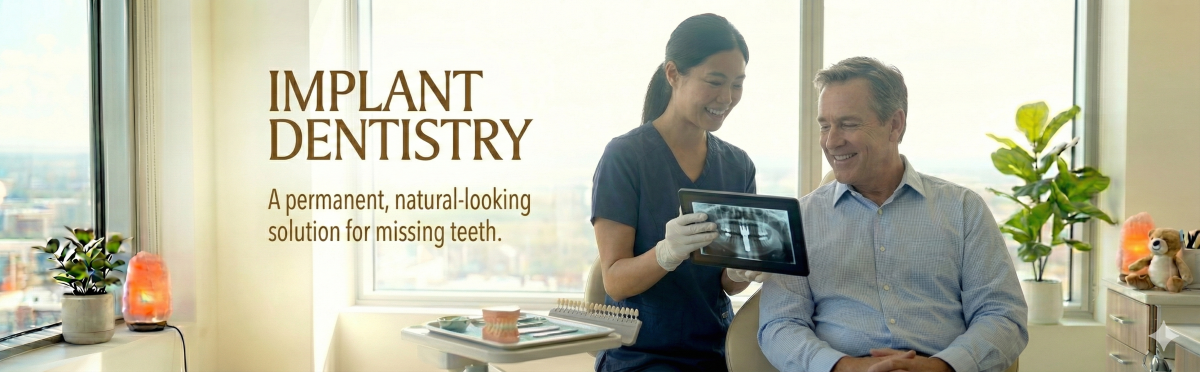
Missing teeth can affect far more than your smile. They can impact your confidence, your ability to chew comfortably, and even your overall oral health. If you are looking for a long-lasting, stable, and natural-looking solution, dental implants are the best choice.
Stamford Dental Studio, located in Stamford, Connecticut, offers comprehensive dental implant services that help people regain full functionality, aesthetic appearance, and optimal long-term oral hygiene. We develop individual therapy plans to restore missing teeth or entire arches of similar teeth, balancing the creation of beautiful smiles with the highest standards of care.
Why Dental Implants Are the Gold Standard for Tooth Replacement
Dental implants are small titanium rods that are inserted into the jawbone to serve as a tooth’s root. After the implant is inserted, it fuses with the jawbone through a process called osseointegration. Once healed, it provides a strong foundation for a crown, bridge, or full-arch restoration.
Unlike traditional dentures or bridges, dental implants:
-
Mimic the structure of natural teeth
-
Prevent bone loss by stimulating the jaw
-
Do not slip, shift, or click
-
Preserve adjacent healthy teeth
-
Provide strong biting power
-
Offer long-lasting durability
Dental implants offer the best functionality because they replace the root and visible part of the tooth.
Types of Dental Implants We Offer
Single Tooth Implant
When you have a single tooth that is missing, it is possible to restore your smile with the use of a dental implant that has been designed to hold a custom-made crown on top of it; therefore, there will be no reshaping of the teeth next to the implant, as is done when creating a traditional bridge. The single tooth will have a completely independent appearance from the other teeth and will virtually match the appearance of a natural tooth.
This option is ideal for tooth loss caused by injury, decay, or failed dental work.
Implant-Supported Bridge
If you need to replace several missing teeth that are contiguous and not adjacent to each other, it is also a possibility for you to fill those spaces with an implant-supported bridge. By strategically placing implants, the bridge will be supported by the implants rather than by the adjacent natural teeth.
Benefits include:
-
Stronger bite force
-
Preservation of natural teeth
-
Reduced bone shrinkage
-
Improved facial structure support
Full-Arch Dental Implants (All-on-4 / All-on-6)
Patients who have most or all of their teeth missing can benefit from full-arch implant solutions. With four to six implants per arch, we can support a full-arch fixed denture.
Unlike traditional dentures, full-arch implants:
-
Do not require adhesives
-
Do not need to be removed at night
-
Provide excellent chewing efficiency
-
Feel secure and stable
-
Restore facial contours
Patients can even get temporary teeth on the same day of implant placement.
Implant-Retained Dentures
If you have removable dentures and have experienced difficulty with their movement or discomfort, consider upgrading to implant-retained dentures. Implant-retained dentures snap securely onto your dental implants, providing more stability and support when biting down on food than traditional removable dentures, while still removable for cleaning.
This option significantly improves:
-
Speech clarity
-
Comfort
-
Chewing strength
-
Overall confidence
Are You a Candidate for Dental Implants?
A healthy individual with sufficient bone density qualifies for dental implants. Even if you have lost some bone, methods like bone grafting can help build a foundation for dental implants.
During your consultation at Stamford Dental Studio, we evaluate:
-
Oral health and gum condition
-
Jawbone density
-
Medical history
-
Lifestyle factors
-
Cosmetic goals
-
Budget considerations
Every treatment plan is customized to meet your individual needs.
The Dental Implant Process: What to Expect
The dental implant procedure requires a series of carefully considered steps to ensure long-term success.
1. Consultation and Treatment Planning
We start with a comprehensive examination and imaging to evaluate bone structure and determine the optimal implant position.
2. Implant Placement
The implant is surgically inserted into the jawbone in a minor procedure that is done on an outpatient basis. Local anesthesia is used, and sedation is available for your comfort.
3. Healing and Integration
The implant will then integrate with the jawbone over the next few months, providing a solid base.
4. Final Restoration
The final step is to attach a custom-made crown, bridge, or denture to complete your smile restoration.
The dental implant team is committed to communication throughout the entire process to ensure you are always informed and confident.
Why Bone Grafting May Be Needed
If teeth have been missing for a long time or have been affected by gum disease, bone loss may occur. Because implants need good bone support, a bone graft may be indicated to replace the lost bone.
Bone grafting:
-
Strengthens the implant foundation
-
Enhances long-term stability
-
Improves overall treatment success
With good planning and care, the success rate of dental implants is over 95 percent.
Long-Term Benefits of Dental Implants
Implant dentures offer many benefits beyond cosmetic appeal.
-
Maintains jawbone health
-
Prevents shifting of remaining teeth
-
Restores natural speech patterns
-
Enhances chewing efficiency
-
Supports facial structure
-
Boosts self-confidence
Unlike traditional dentures, dental implants are a permanent solution to your smile, allowing you to eat, laugh, and speak freely without concern.
Frequently Asked Questions
Are dental implants painful?
Most patients report minimal discomfort. The procedure is performed under anesthesia, and post-operative soreness is generally manageable with medication.
How long do dental implants last?
With proper oral hygiene and regular dental visits, implants can last decades and are often considered a permanent solution.
Are dental implants expensive?
Although implants have a higher initial investment compared to dentures or bridges, their durability and longevity often make them more cost-effective over time.
How do I care for dental implants?
Care for implants the same way you would natural teeth—brush twice daily, floss daily, and attend routine dental checkups.